Saturday, 17 August 2019

On Spitfire Hill


On Spitfire Hill

Last night I walked on Spitfire Hill in the evening cool as the sun executed its final descent. It seems this summer, despite the recent rains, seems to go on forever, the extended heat perfect fodder for the BBQ lifestyle marketeers. Staycationers laugh, as well they might, in the face of airport meltdowns.

Chattis Hill airfield now known as Spitfire Hill
Spitfire Hill, despite its name, is not what most people would regard as a hill. It is gently sloping grassland, what we more commonly call around these parts downs when we are not pretending they are hills. The Spitfire bit, as you might imagine, has something to do with the British fighter plane - two stories exist as to why, one I know to be true and the other I would like to be true.

The first, which is based on fact, is that this bit of land was used during WWII as a storage airfield, the newly built Spitfires flown here from the bomb vulnerable Southampton factory before being dispersed to their battle squadrons. The other is that three years prior to the outbreak of war a group of Air Ministry officials gathered on this vantage point to watch an aerial demonstration of the as-yet-unnamed Merlin engine powered prototype. Their mission on that morning was to decide whether to put the aircraft into production or not. Had the decision gone the other way I'm certain I would not be writing this today.

As I walk eighty plus years on from that time all evidence of that past is long gone but the sound of aircraft still fills the air. Away in the distance trainee Apache helicopter pilots are circling a current airfield in the gathering gloom at the Middle Wallop Army Flying School. I guess these must be the rawest of new recruits for they don't venture beyond the boundary fence to endanger the lives of us local citizenry as they yaw, dip and track sideways in quite alarming fashion. You'd think the intrusion would be annoying, but the creature-like nature of the Apaches and the very randomness of their flight is endlessly fascinating to watch. As are the swallows.

They are, in must be said, considerably more nimble than the Apaches as they skate no more than a foot above the downland turf, their trajectory perfectly mimicking the contours of the land in a constant search for insects. They are a bit like trout; they know what they like. And when they like it, they will feed for hours on one particular bug to the exclusion of all others, homing in with an ocular vision that is more akin to the raptors than birds of a more normal type. The bumble bees who work the grassland with equal diligence are buffeted in the wake of the swallows, who for reasons that I guess are obvious, rarely eat them.

The activity of the swallows, their southern departure less than a month away, is a reminder that more of the summer is past than ahead. As is the dust thrown up by the combine harvesters, that is so dense and all-pervading that the last rays of sunshine are seen through a dirty filter as the teams work almost around the clock to capture the last and best of the summer weather. Full grain stores are the harbinger of autumn.

I see all this from the highest point of Spitfire Hill; the walk home is all slight downhill. The neighbourhood hare ambles off long before I get near but the young badger continues to scratch in the turf as I get closer than I have any right to do. I have discovered over the years of this walk that if I continue straight at them without altering my pace or posture they simply don't notice me. Sometimes I'll get almost within touching distance, standing immobile until, eventually, I'm noticed and off he or she heads towards the hawthorn scrub with that rolling gait badgers pretend is a run.

It is nearly dark by the time I get close to home. A grain wagon thunders by, the tractor driver giving me a cheerful wave from his air-conditioned cab, the orange hazard light on the roof apparently strobing to the beat of his music. I return the wave such is the nature of our rural etiquette. An apparently insignificant act that seems to bind us in some common purpose that is probably more imagined than real. But it is enough to make you feel good about not just about yourself but the world in which you live.

Fly on the road

You've heard of mobile banks. Post offices. Libraries. Surgeries. Well, now the Montana fly shop Fins & Feathers based in Bozeman, the fly fishing capital of mid-West America, have gone one step further with an on-the-road fly store.

Like many a good idea it has come about by accident; the guys at Fins & Feathers knew they needed a new outpost to supplement their shop of 18 years but could not decide between a variety of locations. So, in the absence of an overwhelming vote for one particular place, the Flyfish Truck was born.

It is more than just a fully loaded fly shop because it is also kitted out to be a window on the world of fly fishing. A beacon in car parks, shopping malls, festivals and apparently random events to bring newcomers into our great sport by showing that fly fishing is both damn good fun and really not very difficult to learn.

A brief look at their roadshow calendar for August and September shows how wide and diverse they intend to take the message: music festivals. Car shows. Brew-ins. Universities. Shopping malls. Fishing lodges. All with free casting clinics, advice and of course, the chance for locals to stock up on the latest gear.
  

Notes from a fly fisher's life
Yet More Sweet Days is the latest book from the leading South African fly fishing writer Tom Sutcliffe charting his pursuit of trout around the globe. 

Naturally his home country features greatly, but there are chapters amongst others on Iceland, two chapters on the chalkstreams and one on my favourite topics of all, fishing trucks, plus another on the flies of Ollie Kite.

Tom's book is out now in paperback from Amazon at £9.03.


Special Offers

My August special offers are still running. Here they are:

HALF PRICE (£87.50 instead of £175) for selected weekdays during August.

SAVE £40 Book a Rod on the carrier (£55) and receive a ticket for the catch & release lake (value £40) for free. The photo is of a happy Sam Macleod who took advantage of the offer.

2 FOR 1 Book two rods for the price of one (so £47.50 each) during the remainder of August.

Save £100 (was £450 now £350) on two days and one night at The Parsonage for up to four people. Call or email for dates/booking August 24th-31st.


The Quiz

As ever the quiz is just for fun, with answers at the bottom of the page. 


1)      Which year (excluding this one!) recorded the wettest August in the UK?

2)   How many Spitfires were produced and how many survive to this day?

3)      Who designed the Spitfire warplane?


Have a good weekend.


Best wishes,
Simon Signature    
Founder & Managing Director


Answers:

1) 1912
2) Over 22,000. 179 survive.
3) Reginald J. Mitchell


Sunday, 4 August 2019

Blue water thinking

Blue water thinking
 
 
Often people look a little glassy-eyed when you mention fishing; "I don't have the patience." they say. At that point you'll try to explain that fishing, fly fishing in particular, isn't about inactivity.

In fact, you'll say there is more to it than simply catching fish. Frankly, they won't believe you. Or think you to be deluded. And if you get a bit evangelical about it all, emphasising the holistic, they will do everything in their power to escape your conversational clutches in the shortest time possible. "But it's true." you will wail at the departing back of your erstwhile buddy.
Holism was termed by the South African statesman, military leader, and philosopher Jan Smuts in the 1920s. The idea that systems and their properties should be viewed as wholes, not just as a collection of parts. Or put another way the whole is greater than the sum of its parts. For me that is true of fishing. If it was just about catching fish I would not bother. Nor would I suspect would you. 

Every survey that asks anglers why they fish puts 'catching fish' well down the list of reasons for pursuing our pastime. Getting away from it all. The allure of water. Spending time with friends. Enjoying the outdoors. Being close to nature. These, and others, all rate higher. Ultimately a day spent fishing, whatever the outcome, makes us feel better about life and about ourselves. It uplifts our souls. Nourishes our belief in life itself. But have you ever asked yourself why? Well, Professor Michael Depledge at the European Centre for Environment and Human Health (ECEHH) in Plymouth has and the reason is, at least in part, the concept of blue space.

The concept of green space is well known: show a sample group a series of photos in which the amount of greenery increases then their stress levels decrease. In the latest iteration of this test by Depledge he introduced water ranging from ponds to full blown coastline: stress levels were reduced yet further. To test the theory in everyday life Depledge and the ECEHH team delved into self-reported health data from Natural England based on postcodes to see if health varied according to proximity to water. It does, with Depledge concluding, ".... we (ECEHH) found that the closer you live to the English coast the healthier you are. There was some evidence that other aquatic environments helped too."

So, there you have it. Throw away the drugs. Cancel the psychiatrist. Fishing, with its proximity to blue space, is the secret to emotional and physical wellbeing. Though it must be added that it is not all good news if water happens to be your unwanted neighbour. Jenny Roe, lecturer in the School of the Built Environment at Heriot-Watt University in Edinburgh, points out there is a downside: the psychological trauma of living in a flood risk zone. Speaking as one who leapt out of bed in the dead of night last week to open sluices when the thunderstorms arrived, I can sympathise .......

Wall of pain

What is this photo all about? A montage by a lure fishing obsessive? Some weird art gallery installation? The trophy board at a fishing club? Let me give you a clue: it hangs on the wall of an upstate New York hospital.

The wall of pain
For the past twenty plus years Gary Nye, a physician assistant in the emergency room at the Adirondack Medical Centre has been removing fishing lures from every part of the body you can imagine (yes, even that one ....) the relieved patients donating their lure to the wall of pain.

What is Nye's technique for removal? Well, with the benefit of anaesthetic he doesn't generally have to resort to snipping the barb or pushing the hook all the way through. He simply grasps the hook with a suture holding device "And then", he says, "with a little twist and flip of the wrist, the hook comes right out."

I think this simply proves barbless is good for both fish and fishers.


Kayaker vs. Angler

The world is an increasingly crowded place. As anglers we see that up close and personal. The riverine idyll becomes harder to find with each passing year as we are not the only ones drawn to the beauty of water.
Part 3: Kayaker x Angler | Finding Common Ground
Kayaker x Angler 

Walkers. Paddlers. Swimmers. Boaters. Hunters. Canoeists. Dogs. It is a long list of competing desires and opinions seeking different things from the same resource. And it is not always pretty. One man's pleasure is another man's hell.

In a series of films sponsored by Colorado, USA brewer Fat Tire filmmakers attempt to square this a particular circle bringing together a kayaker and angler who share a common interest: the river. Visit the Fat Tire You Tube page here for the trailer and the three films: Climber vs. Hunter, Wheeler vs. Biker and Kayaker vs. Angler.


How did you spend the hottest day ever?

I don't know about you but as the mercury crept towards the British record 101.7F (38.7C) at the Cambridge Botanical Gardens last Thursday (25 July) I headed fishing. Admittedly I didn't get to the river until gone 4pm and then spent the time chatting in the relative cool of the wonderfully colonial hut at The Wilderness on the River Kennet.

I think we managed to lever ourselves out of the chairs at somewhere near six as the heat ebbed out of the day, though still in the high 20's that was more relative than actual. I, like my friend, was determined to winkle out a rising fish - it was too hot for speculative casting and sitting on a bench under the shade of a tree waiting for a rise felt plenty industrious enough.
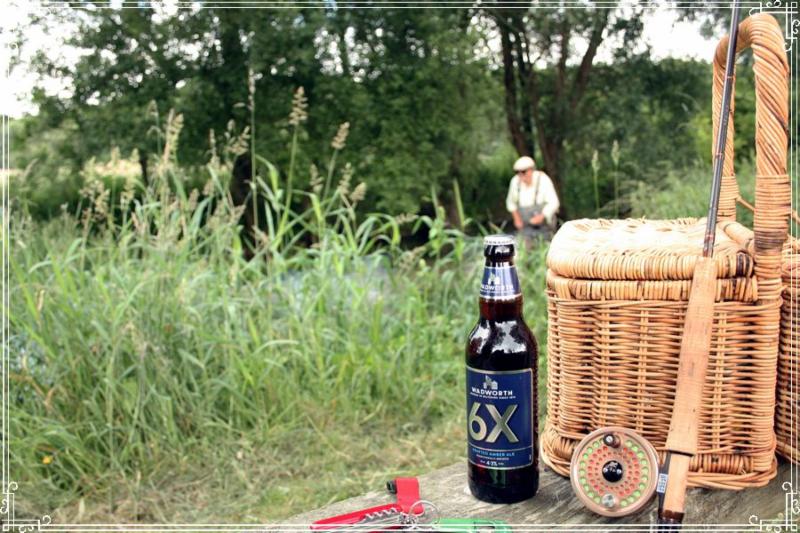
Soon after eight we reconvened beside the cool box. We both had done what we came to do so as the sedges danced above the river and the occasional fish slurped, we shot the breeze until the darkness drove us home sometime after ten. It was the most perfect way to end the hottest day ever.

Talking about heat well done to Adam Jenns who braved a nearly equally hot day to attend the Chalkstream Course at Bullington Manor. Adam, a Fishing Breaks snood, the most perfect protection from sun and wind, is in the post today.


News from Wiltshire

I'm sure the keeper said 6x tippet .....
If you'd like a slightly different view from the chalkstreams I'd highly recommend the occasional e-Newsletter from my friend Bob Wellard at the Wiltshire Fisheries Association.

It covers all sorts of news, views and letters with invites to events and workshops. Click on this link to read the Summer 2019 edition and scroll all the way down to the bottom update your preferences if you'd like to receive Bob's mailing on a regular basis. 

You don't have to be a WFA member but new members are very welcome!


The Quiz

Utterly random this week. As ever, it is just for fun, with answers at the bottom of the page. 

1)      How many, and what are, the primary colours.

2)   Joe Klein's 1996 book Primary Colors was about 
     which eventual US president?

3)      Which town is the capital of Wiltshire?
If you are reading this on some far away beach, happy holidays.


Best wishes,
Simon Signature    
Founder & Managing Director


Answers:

1) Three. Red, blue and yellow.
2) Bill Clinton
3) Trowbridge

Friday, 19 July 2019

In praise of Stockbridge

In praise of Stockbridge

Greetings!

The story as currently spun by the media is that the British high street is not a happy place to be. Rising rents. Onerous business rates. Employment costs. Shoppers with new shopping habits. But as ever it is an incomplete tale, focusing on the monochrome high street that evolved in the nineties and noughties. Scrape away the pleadings of special interest groups and you'll find high streets that are, well, on a high. Stockbridge is one such place. Let me talk you through my local town.

Stockbridge is fortunate to stand at an intersection. It has done so for a very long time. The Romans, an invading force with a penchant for building things rather that destroying them, made this place on the banks of the River Test the nexus for national roads passing east to west and north to south. Later the town became a stopping off point on one of the great herding routes for sheep. Hence the width of the main street and the origin for the name of the town - a bridge over which the stock might pass. Today we stand equidistant between the thriving cathedral cities of Salisbury and Winchester and the commerce centres of Southampton and Basingstoke. As Kirsty and Phil would say: location, location, location.

Three things will collide on the consciousness of any first-time visitor to Stockbridge: our high street is our only street. It is massively wide. And it has huge amounts of unrestricted parking along both sides. The locals are always complaining about the parking: not enough of it. Too crowded. What they really mean is that they can't park within five yards of any given shop at any given moment. Fifty yards is an Everest-style expedition to never be repeated, a hot topic at gatherings in the Wallops. Try going to London I say. Or Basingstoke even.

Of course, our town is quaint. Even most of the new buildings look old. That helps in the battle for shopping hearts and minds. But ultimately the clue to the success of Stockbridge lies in a census of the 40-50 shops that line the street. Only one is a national chain - the Co-Op. All the rest are family owned or proprietor run businesses. We really do have everything except a bank, post office and undertaker but fortunately the Co-Op has those covered. Barber. Bookshop. Butcher. Baker. Chemist. Delicatessen. Florist. Greengrocer. Masses of places to eat, drink, dine, stay or just have a coffee. I won't recite the whole list as you get the idea.

Our marquee building, The Grosvenor Hotel is about to undergo a massive facelift under new owners. The White Hart is building ten new bedrooms. The Vine Inn, a fading pub, has been transformed into a hub for new businesses. Rarely does a property or lease hang around for long. Stockbridge is not alone in this success. Market towns in Berkshire, Dorset, Hampshire and Wiltshire, some bigger, some smaller are similarly thriving.

It is something good to know.

River Test at dawn from the stock bridge


Green algae is fatal

I am indebted to a reader with a holiday home in France who forwarded me a cutting from The Connexion, an English language newspaper with French news and views. On 10 July they reported that an 18-year-old oyster farmer harvesting on the Breton coast may have died as a result of "intoxication from hydrogen sulphide" a potentially fatal gas emitted by the green algae as it decomposes. 

Breton oyster beds where the recent death occurred
They go on to cite the death of a van driver in 2009 who inhaled the gas whilst transporting the algae, a horse the same year and then possibly a jogger in 2016. The French have dubbed annual arrival of the algae, which is prone to bloom in warm weather, the 'green tides' laying the cause firmly at the feet of farming with the Nantes administrative court citing insufficient protection provided by EU and national legislation.

Whatever your views on Brexit it seems that the solution for same the problem our side of the Channel lies in our own hands.


Special Offer priority booking

I'll be running special offers in July and August: 2-for-1's and half price tickets. You will receive news of these in this Newsletter.

However, if you are signed up for the Special Offers newsletter you will receive at least a 24 hour heads up for priority booking.

If you'd like to sign up for the free Special Offer alert, click here. Don't worry if you can't recall whether you've signed up in the past or not; the system is smart enough to tell so you will not receive multiple emails.


The Quiz

As far too many of us will be coping with the contortions of our crowded motorway system over the coming weeks of July and August a few road related questions to ponder as you stare at a littered verge. As ever, it is just for fun, with answers at the bottom of the page. 

Tom Robinson Band 2-4-6-8 Motorway

1)      Which motorway doesn't connect with any of the others?

2)      Which is the longest motorway?

3)      Who wrote and sung the 1977 hit '2-4-6-8 Motorway'

WARNING: Clicking on the TOTP video clip opposite
for the answer to 3) will make you feel very old.

Have a good weekend.


Best wishes,
Simon Signature    
Founder & Managing Director


Answers:

1)      The M2
2)      The M6 at 262 miles
3)      Tom Robinson


Saturday, 6 July 2019

Our kind of vice

Our kind of vice
 

I watched Vice the other day. Before you jump to any conclusions it was on a plane and it is the award-winning Hollywood production starring Christian Bale portraying the life and rise of Dick Cheney, two-time Vice President to George Bush Jnr.

Dick Cheney with daughters Mary & Liz Jackson Hole, Wyoming August 2000
For those of you who don't know much about Cheney the film fills in his back story rising from a pretty-well-nothing hard drinking good 'ole boy in rural Wyoming to the second highest office in the land. He was, and is, an avid fly fisher. Wyoming remains his home, one of the great states of America for trout. It is the original home of the One Fly and a few years back I recall him attending the Awards dinner to present the prizes.

Fly fishing is used throughout the film as analogous to Cheney's life. One reviewer caught the tone of this perfectly, along the way nicely encapsulating the insanity of what we do in the name of pleasure:

"Fly-fishing is a challenging sport that necessitates a willingness to fail over and over again. It is an endeavour that requires infinite patience and cunning. It also requires the ability to read the river's cues to determine where the haul might be most plentiful, and it often takes years of practice until one has achieved an expert, arcing cast, that can hook the perfect catch. It would seem the ideal sport to prepare one to navigate the brackish, infected swamp that is Washington D.C. politics.

It's an easy metaphor Vice uses to help illustrate how a man with no discernible public service aspirations, questionable people skills, and a faulty moral compass that only points to the most shamelessly opportunistic outcomes can quietly rise to the most powerful position in the White House short of the presidency itself."

Vice (2018) - End Credits with fishing flies and America song

I mention all this because as the end credits roll you'll be treated to two minutes of insane fly patterns tied to illustrate Cheney's life: A Rapier missile. Nodding donkey oil well. Shell casing. Surveillance camera. The White House. The Bible. And plenty more some of which I'm still unsure as to what they are meant to represent.

If you don't want to watch the entire film to catch the end credits as ever the internet will come to your rescue with a 2:21 minute clip on You Tube. 

It makes you wonder what flies we might come up with for Brexit: The Movie. Email me with your ideas or your creations. Watch the Vice credits here ....

 
How much do we really care?

I do wonder sometimes how truly engaged we are in saving our planet from self-destruction. We seem to veer between lauding minor victories with drinking straws to feeling good about global commitments by government that we know in our heart of hearts is very probably political window dressing.

But somewhere in the middle the small stuff gets lost. The everyday actions that destroy the very country in which we live pass with little comment. Nobody gets angry. Twitter doesn't blow a fuse. Kids don't go on school strike. Marches don't happen. A few platitudinous remarks are uttered. Move on. There is plenty to see but we simply choose not to look. Last week's news about Southern Water's disgraceful practices struck me as one such moment. If you missed it here's the story in a nutshell.

Southern Water, the private company responsible for wastewater collection and treatment in Hampshire, the Isle of Wight, West Sussex, East Sussex and Kent, were fined £3m and instructed to return £123m to its customers by the regulatory body Ofwat for spills of wastewater into the environment from its sewage plants and for deliberately misreporting its performance from 2010-2017. By acting dishonestly (not my word but that of the Chief Executive, Ian McAulay) they polluted the rivers and seas of southern England from many of their 300 sewage treatment plants; to date we have not been told which plants or where.

There are so many depressing aspects to this story that I barely know where to start. Is it that it went on for a full seven years whilst the body charged with keeping our waters pure, the Environment Agency, failed to notice? It is not as if Southern Water didn't already have form having been fined £20.3 million in 2007 for 'deliberate misreporting' and failing to meet guaranteed standards of service to customers. The then Chief Executive Les Dawson said: "Today's announcement draws a line under a shameful period in the company's history". Well, it didn't then. We only have hope that it will today.

Or is it that Southern Water are, for the most part, being asked to pay back to their customers the money they took for not doing the job in the first place. It is, by the way, just £61 per household, spread over the next five years. £17 this year and £11 over the following four years. About 5% of an annual bill. Just for the record in the period 2010-17 Southern Water made a profit of £834m.

But I guess in the end what depresses me most is that nobody seems surprised or angry. We expect water companies to cut corners. We anticipate that the environmental oversight will be inadequate. We know the financial pain watchdog inflicts will be nip rather than a bite.

Only 14% of our rivers are classified as in good health. Are we surprised?


Kris Kent nets the job

I am delighted to announce that Kris Kent will be taking up his new position with us in early August. Kris, who many of you may know through his current job in the Stockbridge Orvis store, as a One Fly Guide or for his volunteer work with the Wild Trout Trust, will be based here at Nether Wallop Mill.

Kris Kent
Kris Kent (l) with Michael Jacobsen (r) Biggest Fish award 2018 River Test One Fly
His commute is actually not many more steps than mine - he lives in the village. That said he'll be as much out on the river guiding, teaching and assisting river keeper Simon Fields as in the office. Actually his arrival will herald a bit of a change of pace for Diane and myself for after working out of The Mill for more years than I care to recall we are moving into a newly built office across the other side of the road.

I have carved it out of the side of the chalk down (we unearthed a meteorite in the process) and though it doesn't have the river view it does overlook the meadows and is infinitely more suited to the demands of 21st century technology.
 

A June winner
 
Al Bernstein, the American actor, sportswriter and film producer (he has Rocky V to his credits) once wrote of June: Spring being a tough act to follow, God created June. 

He well could have been predicting June 2019 when we swung from deluges to heatwaves.I had calls from people on the way to the river who had to pull over to the side of the road such was the intensity of the rain. 

Shall I bother they'd ask? I always say yes. Fishing is a fickle sport and I'm yet to catch a fish other than when fishing. And so, it often turned out to be the right call. Murderous morning. Magnificent afternoon. Such is the glorious uncertainty of our pursuit.

Well done to John Davies who fished at Barton Court who wins the June feedback draw. A copy of Green and Prosperous Land by Dieter Helm which I reviewed a few months ago is in the post.


The Quiz

Continuing the normal random selection of questions, with little theme beyond the 
topics in this Newsletter. As ever, it is just for fun, with answers at the bottom of the page. 

1)      In what years was George Bush Jnr. in office as President of the USA?

2)      When was the first Cricket World Cup played?

3)      How much does an Imperial (UK) pint of water weigh?
Enjoy the weekend.


Best wishes,
Simon Signature    
Founder & Managing Director


Answers:

1)      2001-2009
2)      1975
3)      1.25lbs